VIENNA TO BRNO
Day 5
Vranovice to Brno

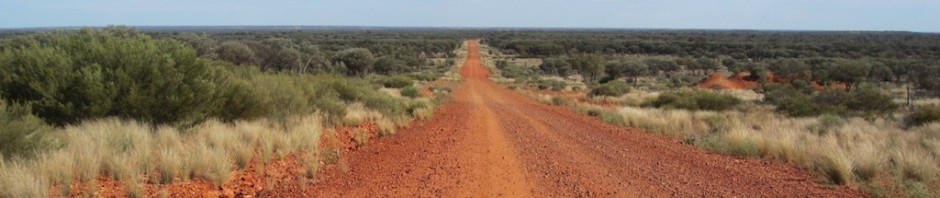
An isolated shed on a one tree plain.
On our last day from Vienna to Brno in the Czech Republic our tyres were well and truly fixed to the Eurovelo 9 and we passed through fields being made ready for the planting of winter crops. Throughout the year crops such as mixed grains, pulses, root crops, hops, fruit, vegetables, sugar beet and curative and aromatic plants are grown.
As we came closer to Brno the bike path began to peter out and I was wondering if we had missed a sign. As a way of finding our way to the centre of the city I thought if we stuck to a track running parallel to the railway line we would surely end up at Brno railway station. Fortunately it did and we were pleased with our navigation methods. At the station Bev went off to get a map of the city and I remained with our bikes, as I didn’t want a repeat of the Barcelona Spain event where my camera bag was stolen at the railway station.
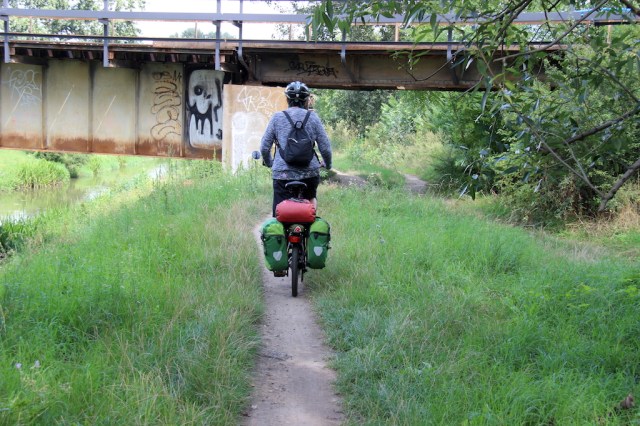
The bike path petered out as we approached Brno.
Our accommodation was booked ahead and we thought we should find where we were staying first thing and get settled. Finding our way from the railway station was a daunting task because not being able to read the road signs it was a case of finding our way by instinct. I carry a compass for such occasions and eventually after riding pot-holed back streets we found our lodgings, a restored villa. The owner greeted us with some gusto after spotting our bikes, as he too was an e-bike enthusiast. He was pleased to show us the one that was powered by a 2000-watt electric motor (illegal in Europe and Australia where 250 watts is the maximum allowable on public roads).
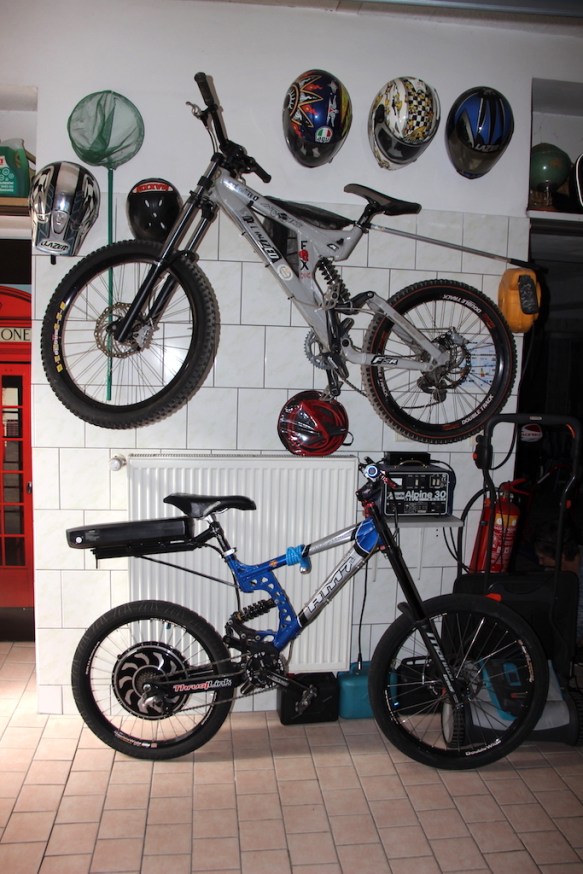
The lower bike is the 2000-watt model; the battery is mounted behind the seat. There is no doubt this bike would have a lot of ‘grunt’.
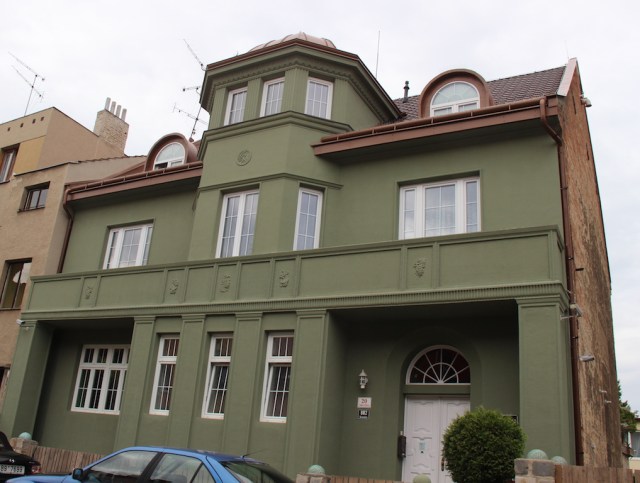
The outside of our lodgings in Brno, a restored villa.
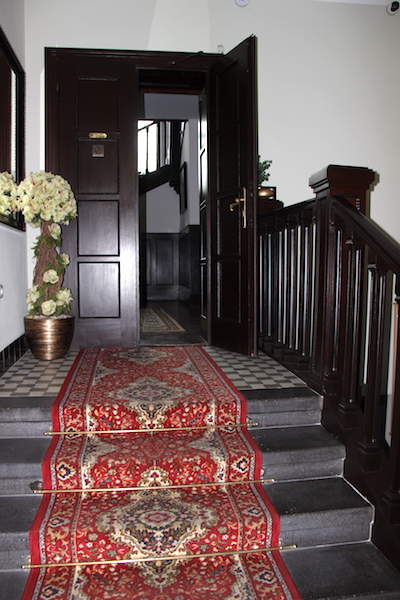
The entrance to level one.
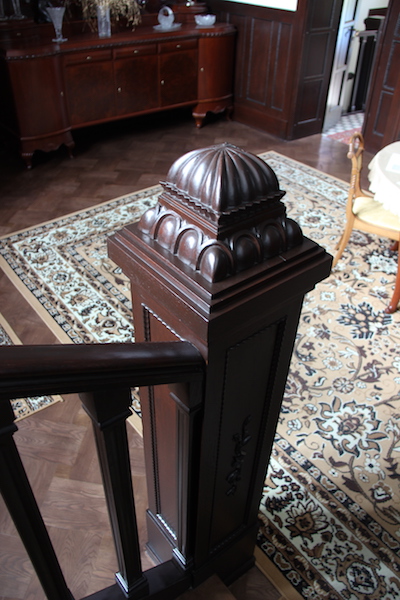
A delicate newel post of the staircase.
Carpenters took great pride in the making of wooden staircases and the making of an impressive newel post was the pinnacle of their trade. There is an English custom when it comes to newel posts. If you owned your house it was customary to insert a small piece of ivory in the top of the post, it indicated you owned the house. I suppose it was a way of saying, ‘Look how rich I am, I own my house’. Or, instead of inserting a piece of ivory in the newel post, a hole was drilled in the post and the rolled up deed document was put in the hole and capped with a decorative plug.
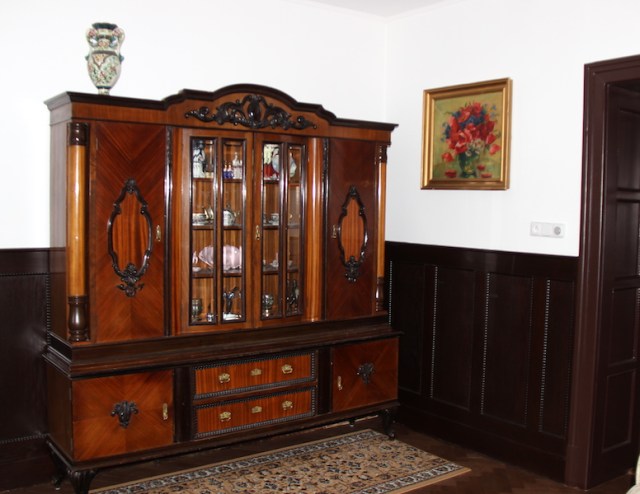
Looking closely at this cabinet I could see it was probably old and worth a fair amount of money. Beautiful craftsmanship.
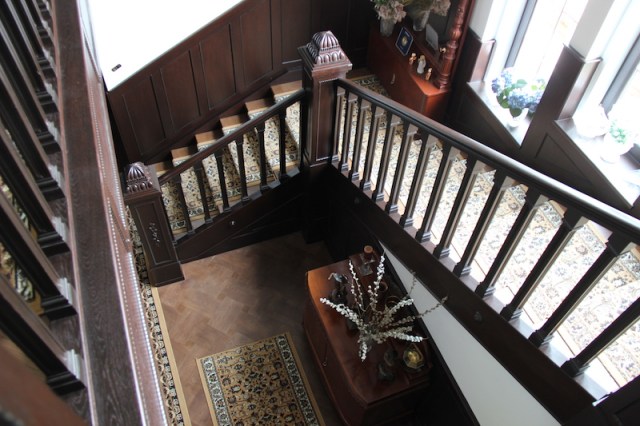
The staircase from level one on which our room was located.
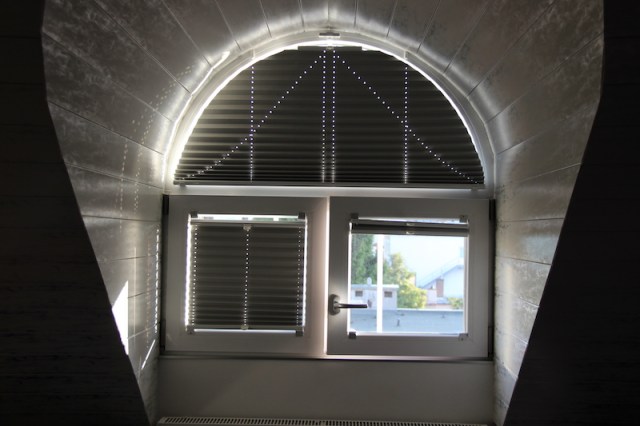
The window in our room. Lying on the bed and studying the surroundings for me is a form of meditation.
Day 6 Brno
Brno has a population of about 400 000 people and it is the second largest city in the Czech Republic after Prague. The valley in which Brno sits has been occupied since medieval times and having such a long history the locals celebrate its history on a regular basis. The city spends about 30 million euros every year on culture and when we were there a festival was underway with people dressed in historical costumes.
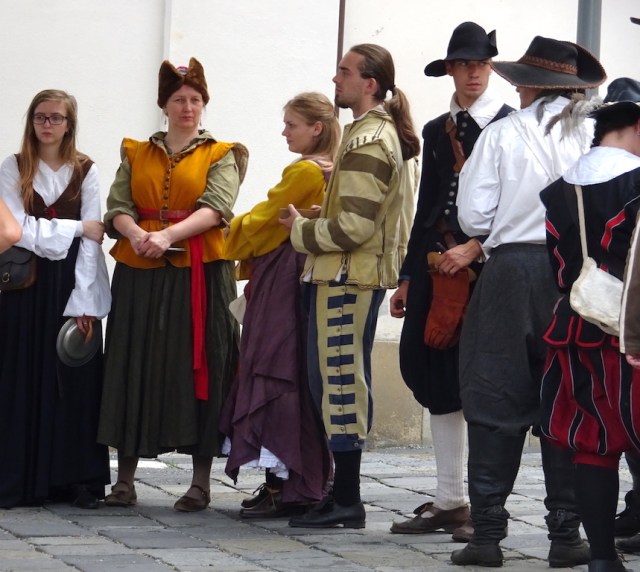
People in Brno dressed in authentic costumes of the period.
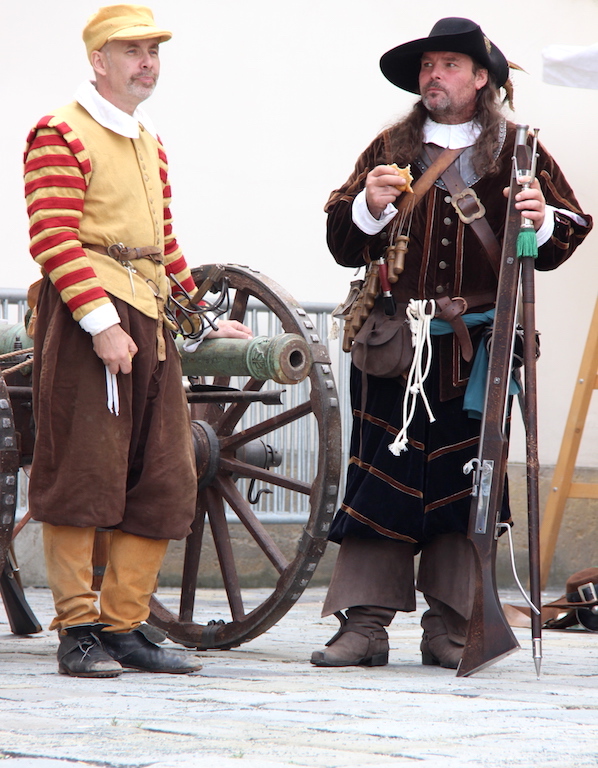
Dressed for the part from head to toe. What are the pieces of string hanging from the belt of the warrior on the right? Maybe pull-throughs for cleaning the musket….?
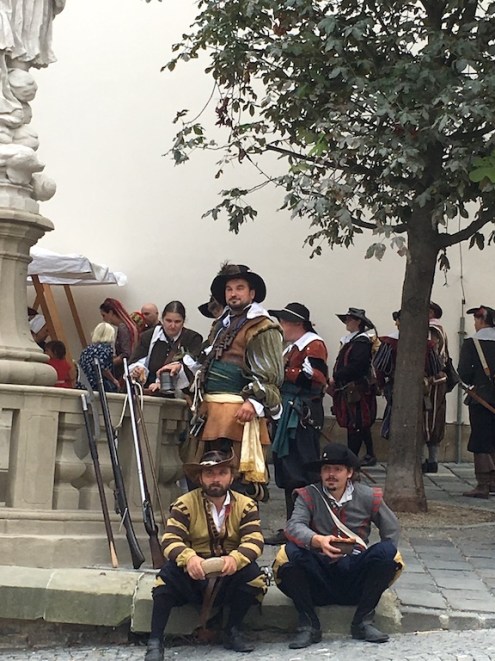
Lunch is a necessity during festivities in Brno.
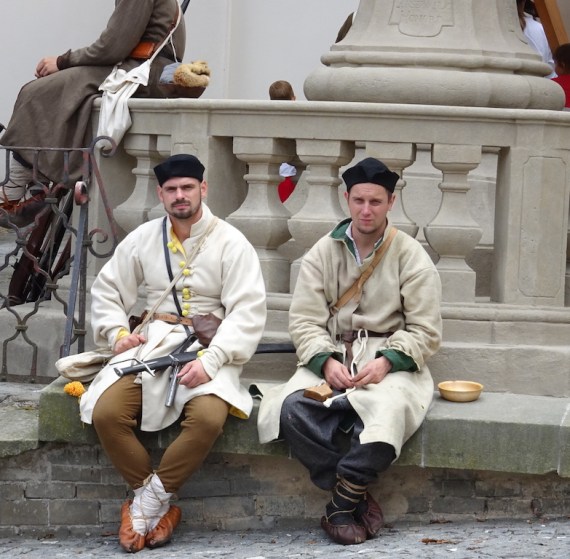
The dour look of ancient warriors in the square of Brno.
Previously I mentioned that we found that many of the people of the Czech Republic are not outwardly friendly or full of smiles and the two warriors above are typical of the looks we received when travelling in the republic.
Around the city there were a number of classical forms of architecture including telemons.

Male figures supporting a load on their shoulders are called telemons.
To date, I have never found a telemon with a smile, probably because they are supporting a heavy load and thus the strain shows on their faces. Columns in the form of a female are called caryatids.
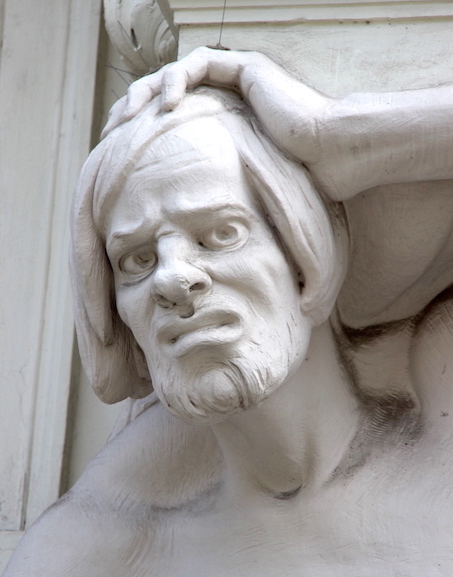
The strain is unbearable.
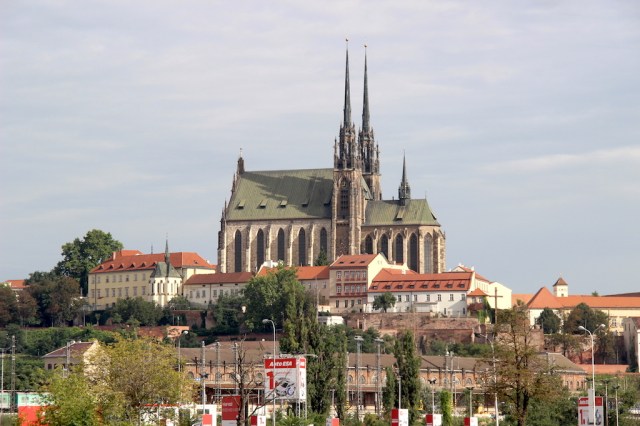
The Cathedral of Saints Peter and Paul.
Churches and cathedrals are often located on the highest point in town. Does this mean parishioners are closer to heaven? Hill tops were chosen to build churches on as the church then maintained a dominating position.
Just another cathedral you say, but this one is different. The unusual thing about this one is the bells are rung at eleven o’clock in the morning, not at midday, as is the case with other cathedrals in Europe. According to legend, during the Thirty Years War with the Swedes a Swedish commander promised, when laying siege to Brno that the attack would be called off if they had not succeeded in taking the city by midday. A cunning citizen decided to ring the bells at eleven o’clock, fooling the Swedes in to breaking off the attack. The event was commemorated in 2010 by building a clock monument. The astronomical clock, in the form of a granite bullet, doesn’t have a face but four outlets from which a glass marble ‘pops out’ at eleven o’clock. If observers can guess the hole from which the marble emerges they may catch it and keep it as a souvenir, if the marble is not caught it returns to the clock.
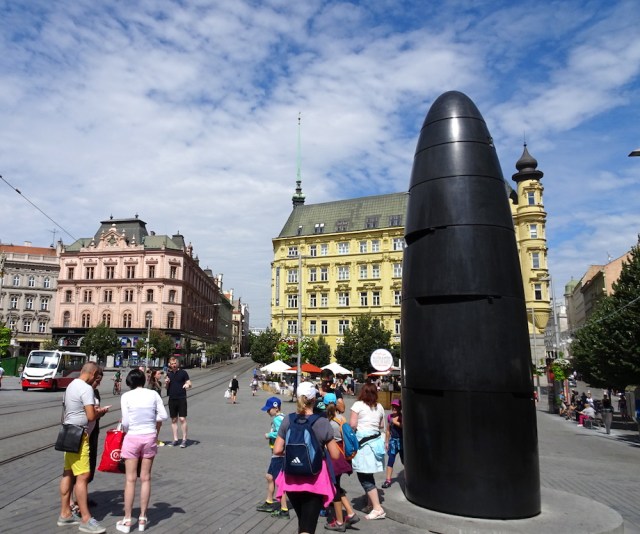
The memorial astronomical clock in the main square of Brno.
Not everyone is impressed with the clock and one such person is Christopher (of christopherblogspotbrno) and to quote him: ‘Back in September 2010, a new clock was unveiled…….A few think it is interesting. But I haven’t met anyone who thinks it is the coolest thing ever. Most people don’t care for it’.
The cost to build the clock was around 520 000 Euros. It does tell the time if you are in the right place and have written instructions at hand. The clock was, as Christopher says, ‘interesting’.
There were a number of other interesting things around Brno such as the busker with a red violin, a violin hanging in a window, a sculpture of a girl sitting on a window sill and a sculpture of a ‘mooning boy’ on a church window arch.
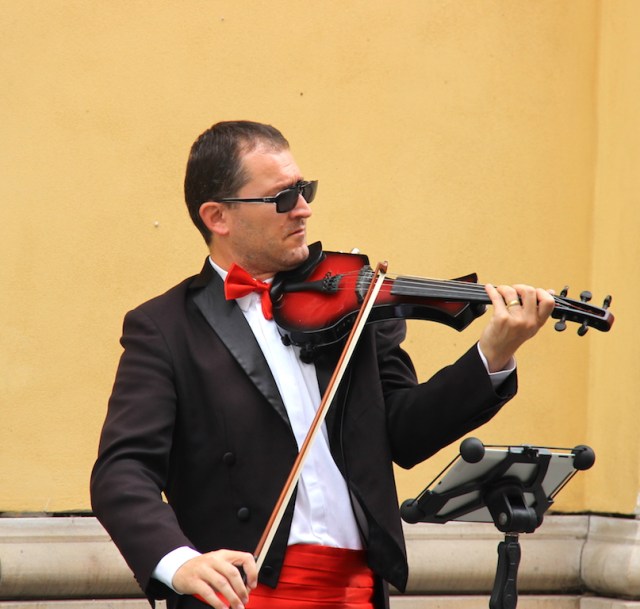
The busker with a red violin.
Seeing the red violin put me in mind of the movie The Red Violin. The 1998 movie is based on the life of a violin maker who supposedly mixed the blood of his deceased wife into varnish and painted a violin with it. The movie portrayed the effect the violin had on various owners over a period of 300 years.
The most renowned violin maker is Antonio Stradivari (1644-1737). One of his violins today can be worth 16 million dollars.
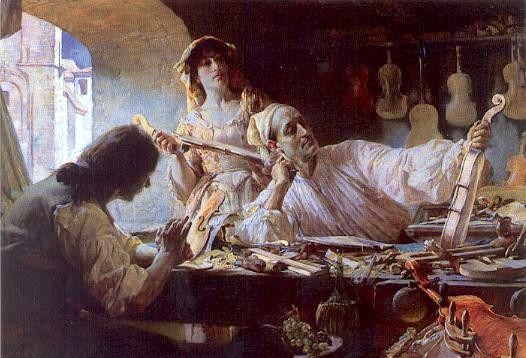
A romanticized image of craftsman hero Antonio Stradivari, by Edgar Bundy, 1893. Image credit: Wikipedia, photographer unknown.
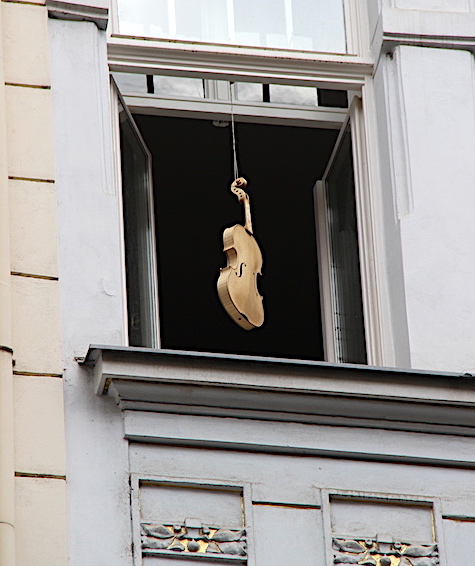
Is this a Stradivarius in the making? The hole in the sounding board of a violin is called the f-hole; one of the two holes can be seen clearly here.
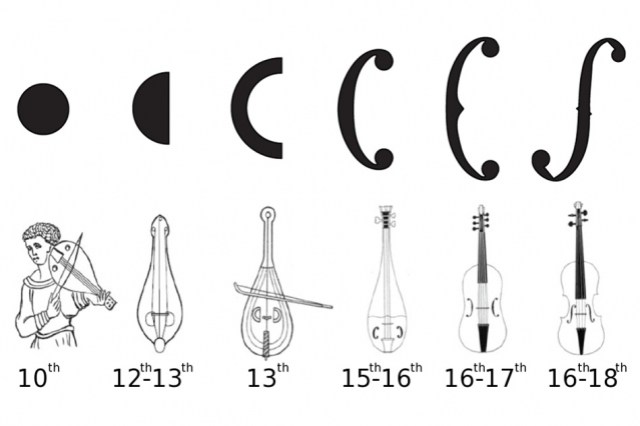
The evolution of the f hole in a violin. Image credit: openculture.com
The Open Culture web page states ‘Before electronic amplification, instrument makers and musicians had to find newer and better ways to make themselves heard among ensembles and orchestras and above the din of crowds. Many of the acoustic instruments we’re familiar with today—guitars, cellos, violas, etc.—are the result of hundreds of years of experimentation into solving just that problem’.
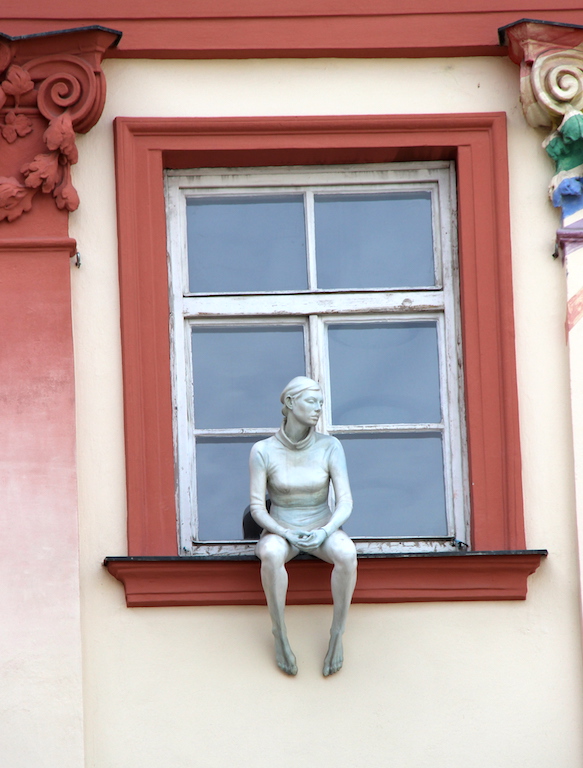
Girl on a window sill.
The mysterious girl on the window sill; I could not find out anything about her.
A sculpture of a two-headed boy ‘mooning’ (exposing his buttocks) seems a little out of place, however due to its uniqueness it attracts people with an interest in the unusual.
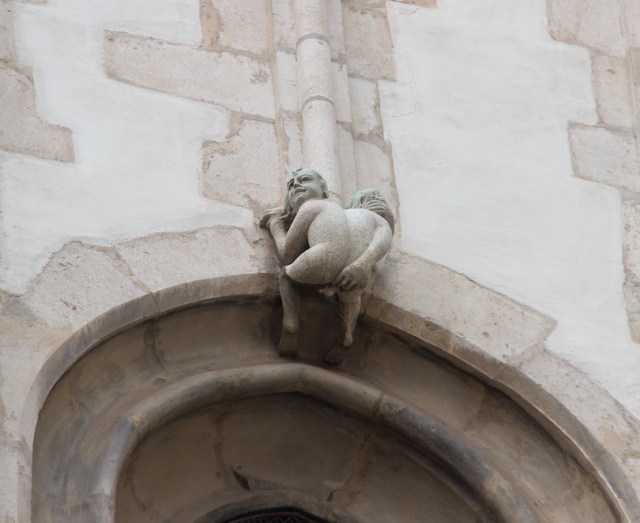
The indecent sculpture on the southern window of the Church of St James, Brno.
There are many explanations as to the origin of the Indecent Little Man and they involve church rivalry between the Church of St James (the one on which the ‘mooning boy’ is located) and the Cathedral of St Paul and St Peter. I will not relate all the theories but one seems reasonably plausible. As the churches were nearing completion it became obvious that the tower of the Church of St James was going to be higher than that of the Cathedral of St Paul and St Peter and so the stonemason at the Church of St James thought a ‘mooning boy’ was appropriate to point out the fact, like thumbing one’s nose at the loser.
Another building with a quirk in Brno is the Old City Hall (now the tourist information centre). The centre is unusual from an architectural point of view as over the entrance are five Gothic spires; four of the five are straight and perfectly executed, however the fifth spire is far from perfect, it is crooked near the top.
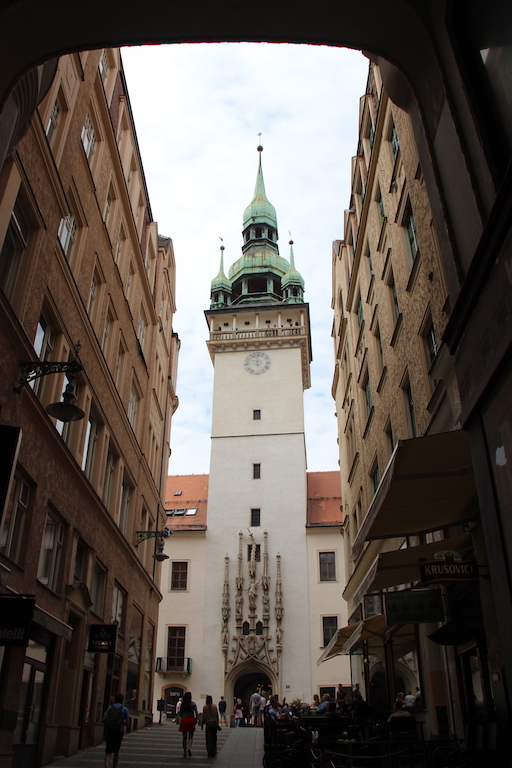
The Old City Hall Brno

The entrance gate of the Old City Hall.

The crooked spire on Brno’s Old City Hall.
Legend has it that the city fathers engaged the services of Antonin Pilgrim to decorate the gate with the spires and even though suitable remuneration was promised it never eventuated so the mason decided to make a crooked spire to remind the city authorities of their broken promise. As is often the case with legends there is a second legend (probably passed around by the city fathers) that Antonin Pilgrim was drunk when he made the bent centre spire.
Riding along a back street we came across a Trabant car perched on a roof and it is worthy of a mention here, at least from an historical point of view. The Trabant in the 1990s became a symbol of former East Germany’s stagnant economy and collapse. Over three million of these cars, called a ‘sparkplug with a roof’, were produced up until the 1990s. Production commenced in the 1950s and the style remained virtually unchanged until it was discontinued. In the 1980s the car had no tachometer, headlights, turn indicators, fuel gauge, rear seat belts, or an external fuel filler cap.

A Trabant on a roof. This is an East German equivalent to the VW Beetle.
The roof on which the Trabant is sitting is part of a bunker known as the 10-Z bunker. It was a former Nazi civil defence shelter, however after the end of WW2 it was converted into a nuclear fallout shelter capable of housing approximately six hundred people. The shelter remained a secret until 1993. It is now open to the public.
The Trabant had a 2-stroke motor (similar to a 2-stroke powered lawn mower) and the driver was required to pour a mix of petrol and oil into the fuel tank accessed under the bonnet. By the time the Berlin Wall came down and the dissolution of eastern bloc communist countries, thousands of East Germans loaded their Trabants with as much as they could carry and drove to Hungary and Czechoslovakia en route to West Germany. The route they followed was called the Trabi trail.
The VW Beetle was much more popular. Bev and I drove one during our Grand Tour of Europe in 1972/3. If we were of the right mind we would still be driving a Beetle, if only for old time’s sake, but one has to consider atmospheric pollution from cars these days.

Trabi World. A tourist attraction in Berlin. Image credit: Lotse via Wikipedia.
It appears there could be more Trabants in Europe on rooftops than on the road. It is possible to hire a Trabant in Berlin and tour the city in style. I do like the stretched Trabant limousine on the roof of the building.
 That’s the end of this post. Bev and I hope you enjoyed my ravings. Next stop, Bratislava in Slovakia. Please leave a comment if you wish.

 Fred and Bev's Odyssey