Bratislava to Vienna
August 2019
Day 1
As we rode out of Bratislava I sorted out in my mind the implications of our decision to ride west along the Danube to Vienna. It was only around 100 kilometres, taking into consideration the sidetracks we were bound to take and the fact we would probably get lost.
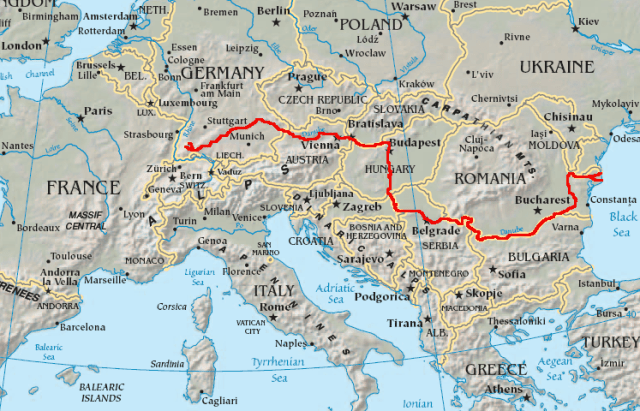
Map showing the route of the Danube River. The river is marked in red. Image credit: Image in the public domain via Wikipedia.
The Eurovelo 6 basically follows the River Danube and we felt comfortable being on it again. For a part of the route the Eurovelo 6 and the Iron Curtain trails are one. Along part of the Iron Curtain trail there were bunkers and other remnants of the Soviet era.
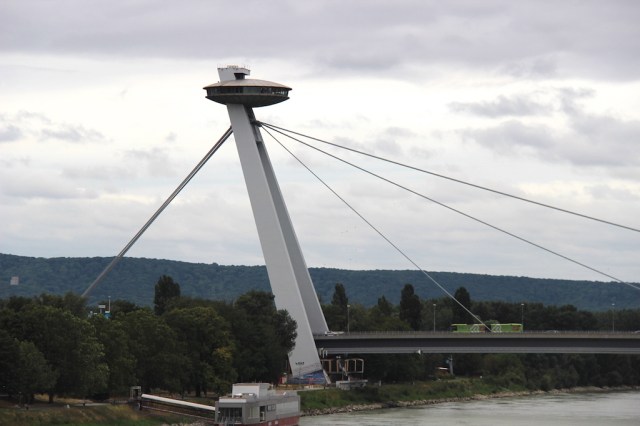
Bratislava’s bridge across the Danube. It is known as the UFO bridge because of the structure on the top which, serves as a restaurant.

A sign ‘Atlantic-Black Sea and Iron Curtain Trail’ indicated we were on the right path.
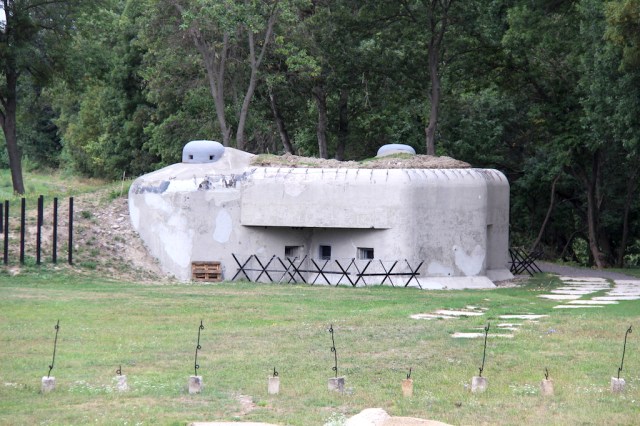
Restored casement (bunker) built in the 1930s.
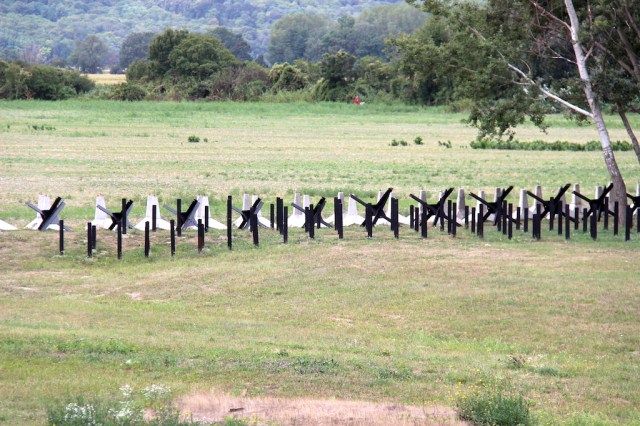
Tank traps along the trail.
Early in the ride we were exposed to fierce headwinds and at one stage I guessed we had gusts of up to 50kph. Our first stop was at Hainburg, a small town on the Danube.
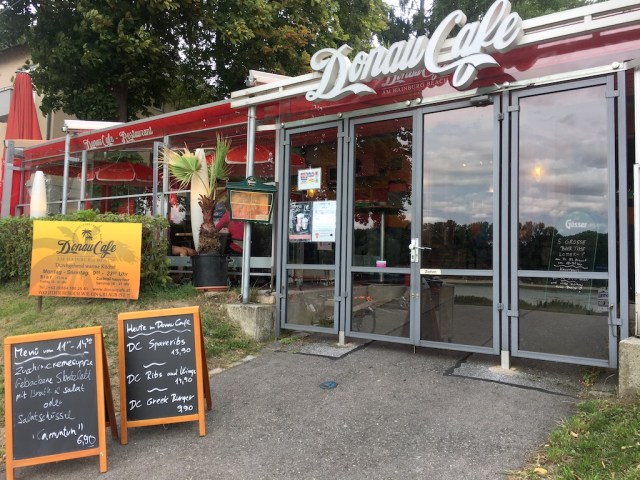
The welcome Donau Café, Hainburg.
While we had morning tea I put our batteries on charge, the batteries had a bit of a draining when battling the headwinds. Café owners have no hesitation in permitting you to charge your batteries, especially if you utilize their services.
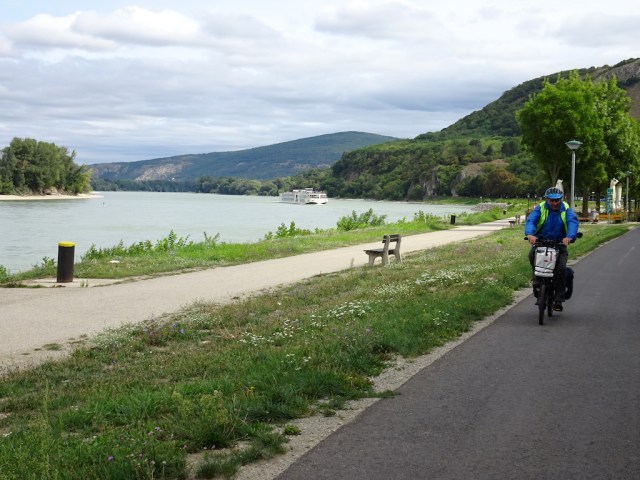
Battling headwinds along the Danube.
In some sections along the Danube there are two paths, either side of the river and because we were unsure which one to take we asked the waiter which of the two would be least windy. The south side was suggested as the northern path went across open wetlands and he thought it would be exposed more to the winds. It turned out the southern path was far from calm as in parts we rode along the top of a levee and were exposed to the full blast of the wind. There were times when the wind was not head-on but coming from the side and on a couple of occasions we were almost blown off the top of the levee. Regardless, we battled on, passing through Petronell-Carnuntum and took a reprieve in a set of Roman ruins. It’s hard to believe that where we rode Roman soldiers once marched. It was exciting to find such ancient ruins standing like sentinels in the surrounding farmland.
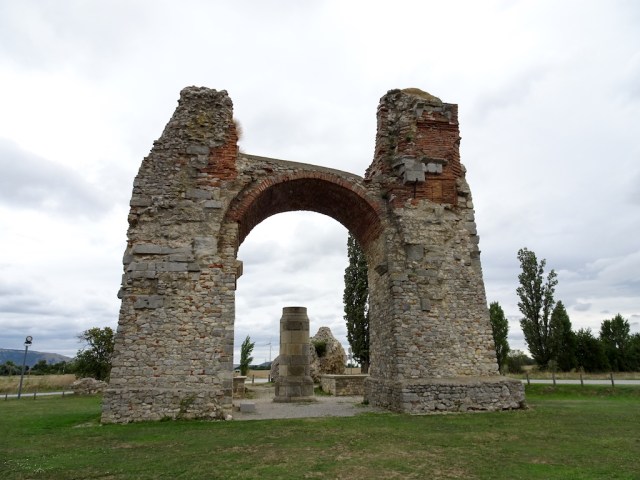
The impressive Heidentor, a partly reconstructed Roman gate tower.
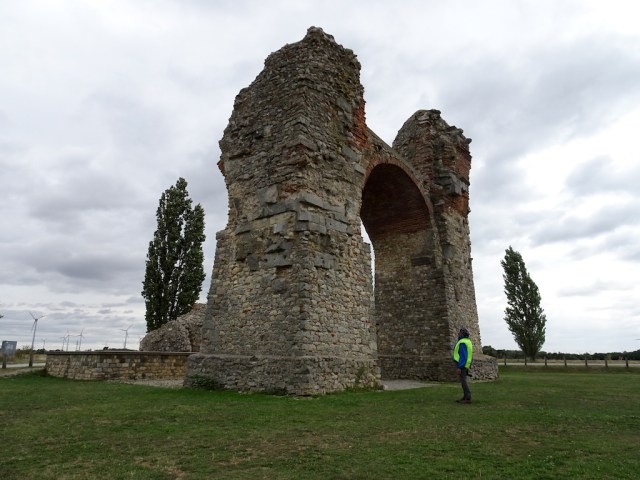
The entrance to the Heidentor. The angle of the poplar trees indicates the ferocity of the wind.
According to the latest research the Heidentor (Heathens’ or Pagans’ Gate) is thought to be about 900 metres from the Roman civilian city of Carnuntum. It was presumably erected during the reign of Emperor Constantius (351-361AD). This will mean little to those not read in Roman history but one thing I did understand was that it was a long time ago and after wandering in the footsteps of Roman soldiers I came to realise the construction of the gate was remarkable.
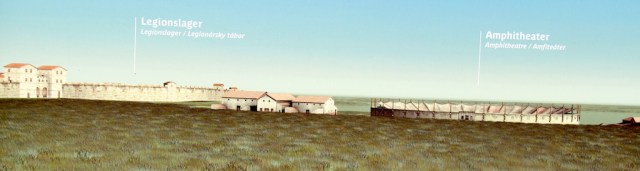
An artist’s impression of the Legion camp and amphitheatre near the Heathen’s Gate.
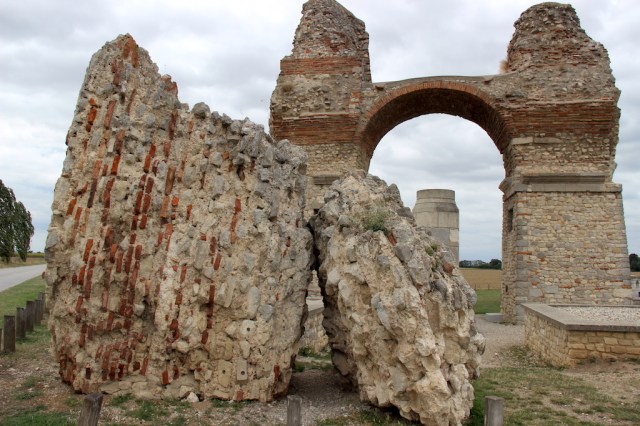
Part of the fallen Heidentor. The fired terracotta inserts intrigued me. Were they a form of reinforcement?
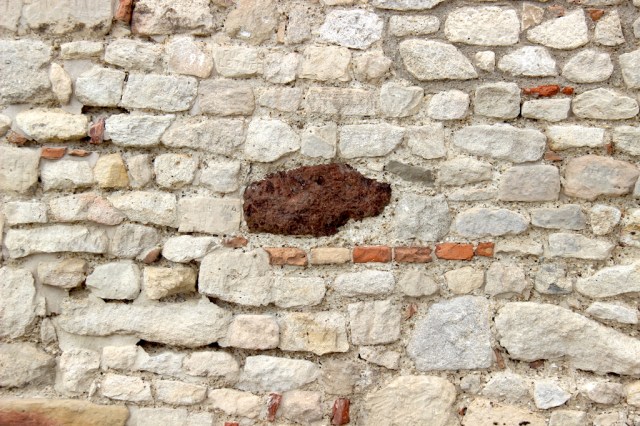
A close-up view of the stonework.
The question I ask is whether these terracotta brick inserts form an integral part of the wall’s construction or was their insertion an artistic expression of the stonemason. I guess we will never know.
A definite artistic expression on a substation nearby was this bicycle.
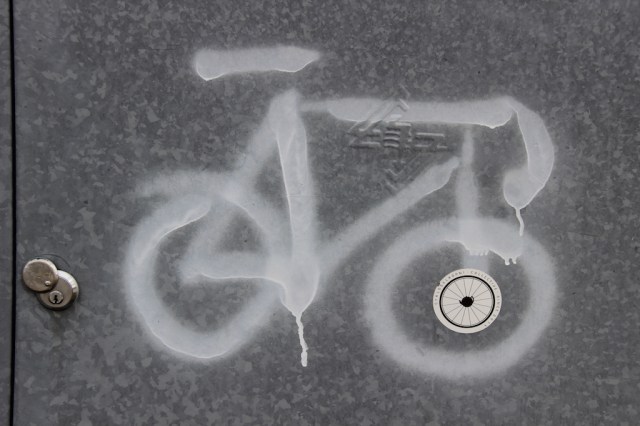
An interesting point about this graffiti is the front hub of the bicycle.
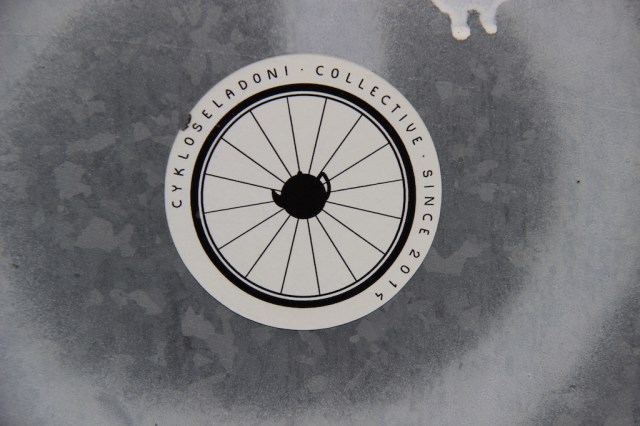
A teapot hub.
Cykloseladoni Collective Since 2014 definitely needs an explanation. In 2014 a group of bike riders formed a collective and their main aim was to encourage people to ride bikes and fight fascism. The collective’s motto is ‘We ride together and play together’. At this present time their latest comment is ‘Ride a bike to fight Putin’ meaning if you ride a bike you do not use Putin’s fuel. This is a result of Russia’s invasion of Ukraine in 2022.
Lunchtime came just after the Roman ruins and the only place out of the wind was between a row of hay bales. This nook would have been a good place to camp. The bales were sufficiently spaced so we could have erected our tent between them. Reflecting on camping we decided it was too early to call an end to the day and we reluctantly resumed battle positions against the wind.
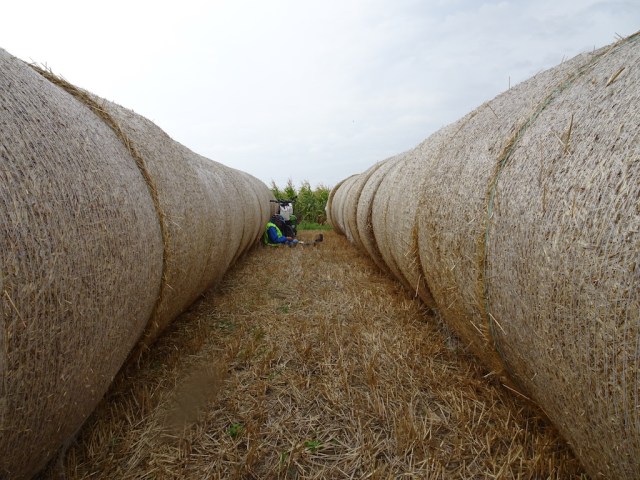
A circular tunnel to new horizons.
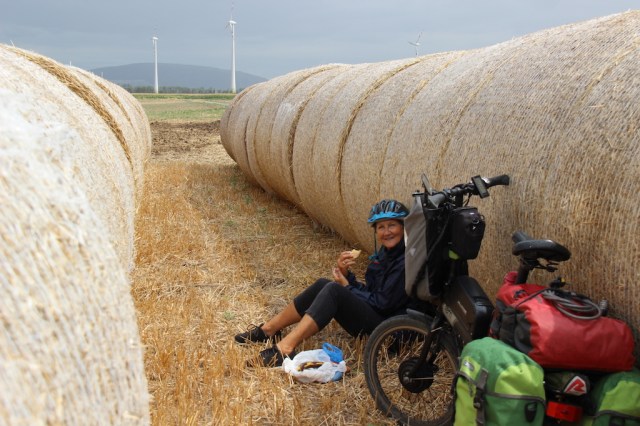
Bev taking shelter and food out of the wind.
Austria is a country intent on the generation of green power and anywhere there is an appropriate surface there are solar panels and anywhere there is wind there are wind generators. Along the route we passed through fields of wind generators. At last count (2022) there were 1372 wind turbines in Austria.
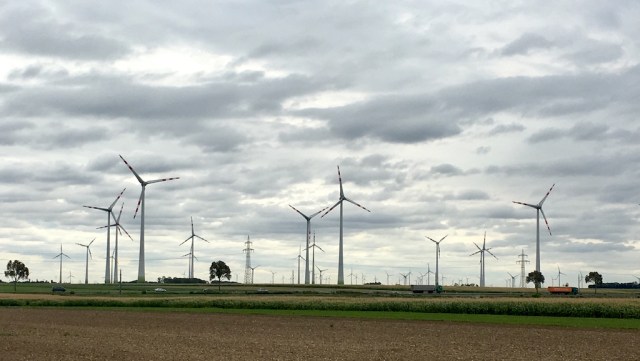
The view from the cycle path.
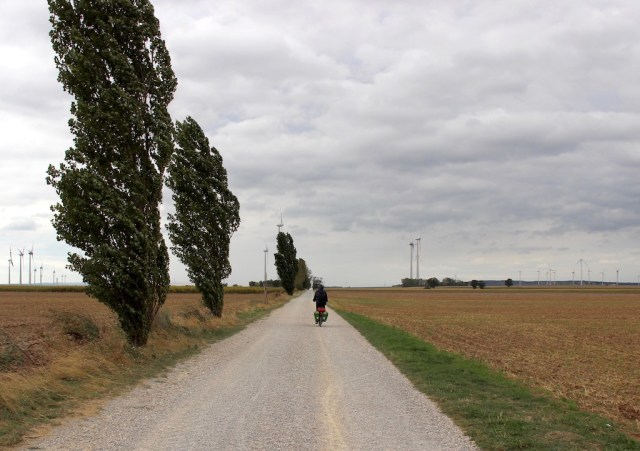
Windswept farmland along the bike path to Vienna.
At day’s end we found ourselves in the village of Haslau an der Donau and decided it would be a good place to rest for the night. Finding somewhere to bivvy turned out to be a frustrating experience as the two hotels were not open. One was closed permanently and the other didn’t open on a Tuesday. Not to be discouraged we waved down a man on an electric scooter and he indicated a zimmer at the end of the street. Knocking on the door a young woman informed us she had no vacancies, I did however ask her if I could plug in the chargers for our batteries and she in effect told us to get lost. Eventually we found another room and as instructed, we bashed on the door loudly. The owner was an elderly gentleman who slept a lot and was hard of hearing. A sleepy, ruffled old man stuck his head out of an upstairs window and eventually made it to the door and let us in. The room was 1930s style, but it was clean so we settled for the night not having achieved our aim to get to Vienna in one day. Our plans were to pass through Vienna the next day and keep going along the Danube on the bike path.
The house where we stayed was a strange place and it reflected the owner’s station and situation in life. Bev and I guessed the owner’s wife had probably passed away and he carried on the renting of the room. There were no towels provided nor was there even a glass. There was a hand basin in the corner and that’s about all. It cost 60 Euros ($88 Au) for the two of us, a bit of a ripoff given what we were provided with.
To thwart our plans of passing through Vienna quickly we received an invitation from our Viennese couchsurfing host, Maria, who we stayed with enroute to Brno. She wanted to host us again so we could meet her husband. My plans went astray but it was a hosting that we were looking forward to. It wasn’t hard accepting Maria’s invitation.
Day 2
The next day’s ride was not without event. We took the downhill path from the village to the Danube where a passenger ferry takes cyclists across the river. The path was a rough and stony affair and led to the water’s edge where there was a sign indicating to telephone the number thereon and the ferry would come across and pick you up. Bev telephoned the number and a recorded message said the ferry was not running that day. But what kind of ferry was it? There was no jetty. Was it a barge that could be driven up on the beach? We will never know.
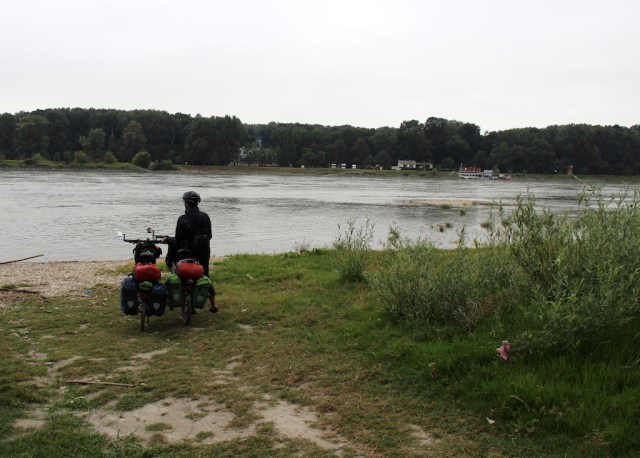
No ferry today.
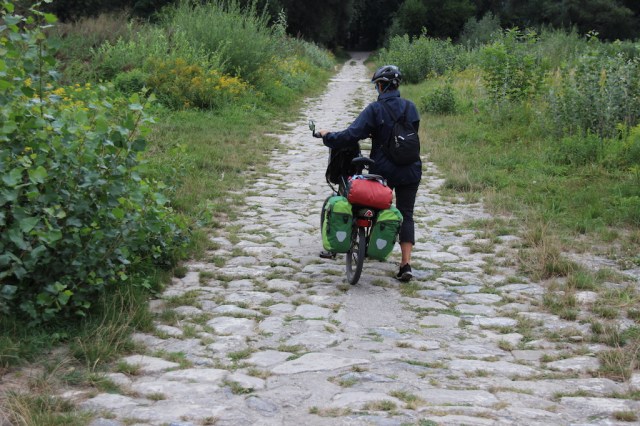
The rough cobblestone haul back up the hill. Some paths are simply too rough to ride.
The absence of a ferry and a storm brewing meant there was no option but to backtrack and continue on the southern side of the river. We had to return up the steep hill we had come down earlier and look for an alternative route to Vienna. Fortunately, the route we chose was basically traffic free and near the Vienna International Airport the bike route became the Flughafen route which took us all around and through the airport, down to the river and along into Vienna.
Apart from riding through the airport there were some interesting things along the way. We rode through a bridge construction site where a sign said ‘No Way’ but there was no way we were going to turn back. As we went through, there were some strange looks from the workers.
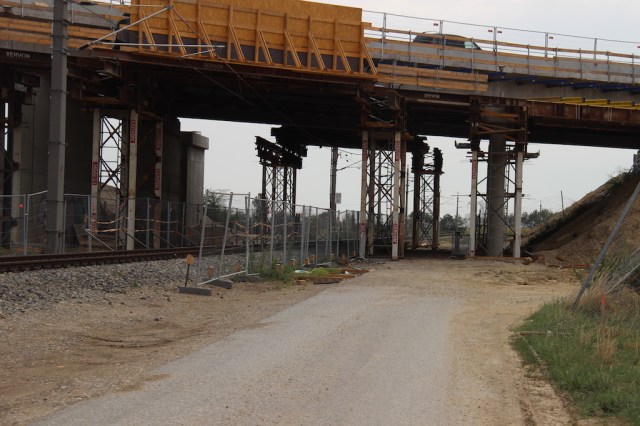
Bridge construction works across our path.
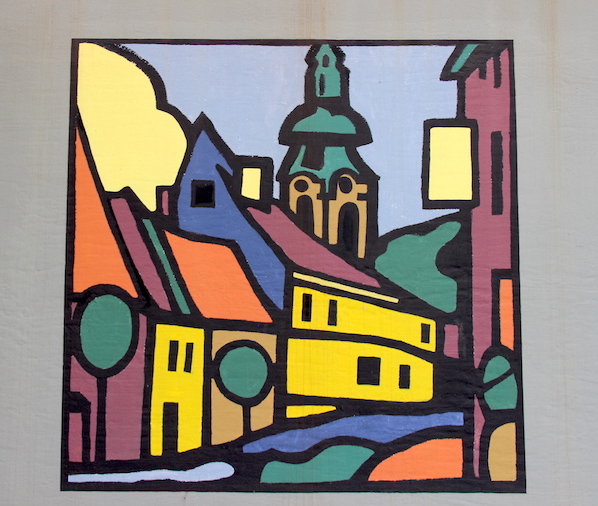
Artwork along the way. The painting is about five metres square.
The bike path went alongside a motorway but we heard very little traffic noise as there was an enormous sound barrier deflecting traffic noise.
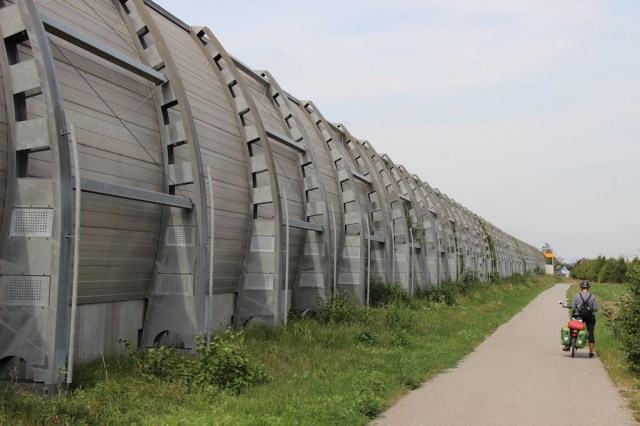
A massive sound deflector between the motorway and the cycle path.
At one point the bike path followed close to the Danube and through an industrial area. Nearby in the area was a Buddhist temple that seemed out of place mixed in with industrial activity.
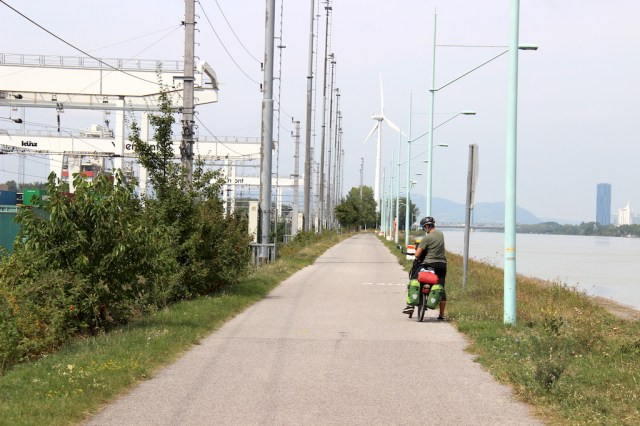
Along the Danube with Vienna in the distance.
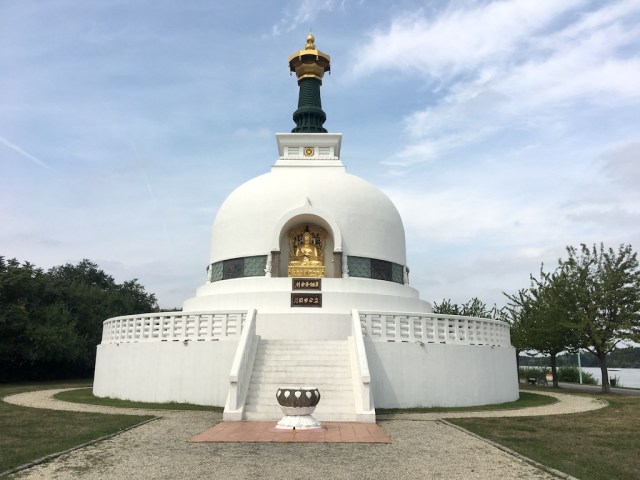
Vienna Peace Pagoda
The name of the temple was ‘Fredenspagode Nipponzan Myohoji’ which, translates as ‘friendship and peace.
The web page ‘Buddhism for Beginners’ quotes Buddhism as a 2600 year old philosophy based on the teachings of the Buddha, or Awakened One. The Buddha’s best-known teachings, the four noble truths and the eightfold path, describe the nature of human suffering and a way to liberate oneself from the existential pain of living and achieving nirvana.
On the outskirts of Vienna we took a narrow, overgrown path through the forest (the south-eastern end of the Prater Park) and it was along this path Bev decided to go bush and attend to a call of nature. To our surprise she came across two dead tree trunks, not just ordinary trees, they had hundreds of old nails and other pieces of assorted metal driven into them. The chance of her discovering these old trees was immeasurable.
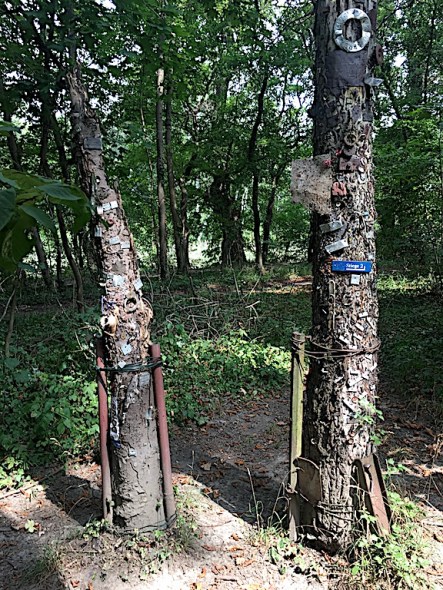
The two dead tree trunks with nails and other metal objects which have been driven in.
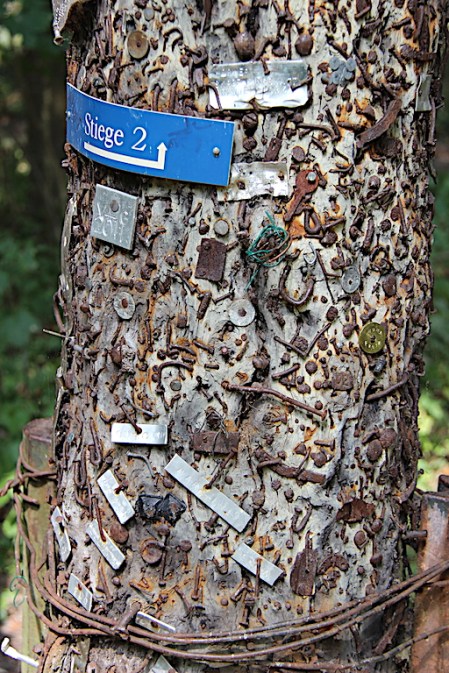
Part of a tree trunk with nails and other metal objects driven into it.
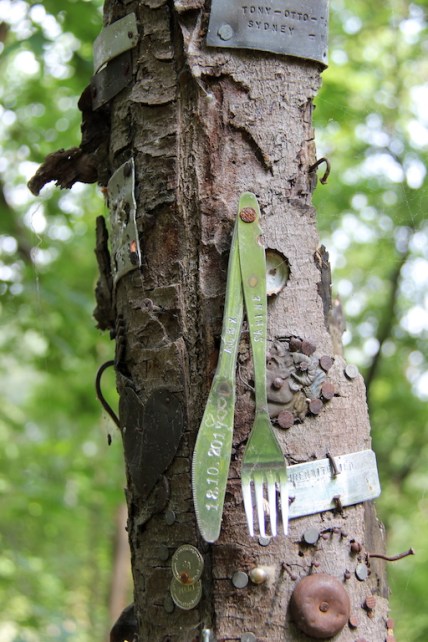
The adorned trunk of a nail tree.
The knife and fork, bottle tops, and other paraphernalia were modern additions but the nails would have been of more ancient origins. Interestingly, at the top of the photograph there was a stamped plaque, shown in the next image. I wonder who they were, especially in light of Sydney being mentioned.
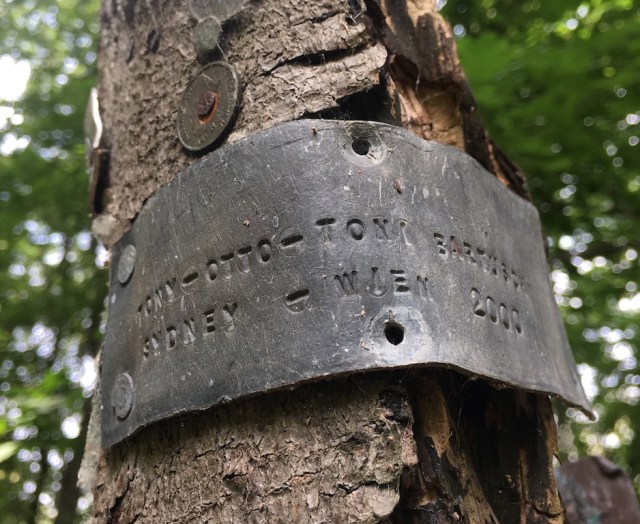
The Tony-Otto plaque on a nail tree trunk.
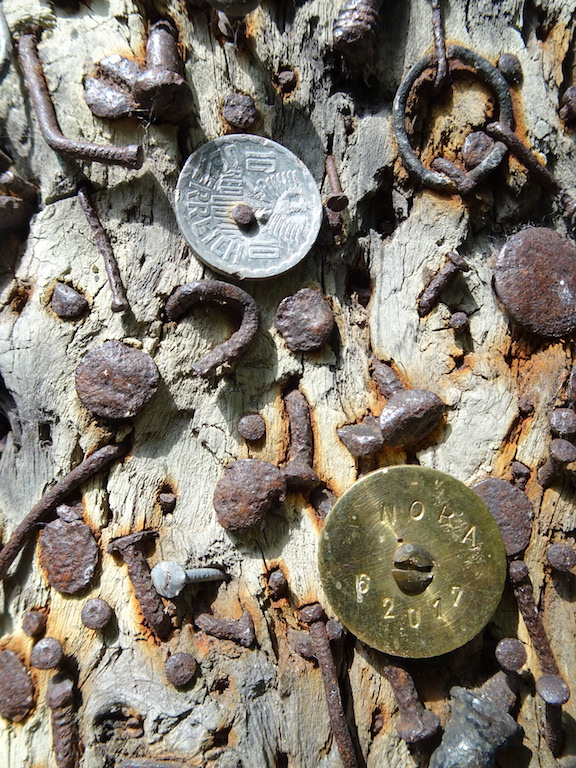
Close-up of the nail tree trunk.
My assumption is the trees were a part of the ritual of driving nails into trees in a quest for good luck.
While researching European nail trees I came up with many interesting facts including the existence of a nail tree in Vienna commemorating the odd custom. Bev and I went searching for the Vienna nail tree and found it near Stephanplatz.
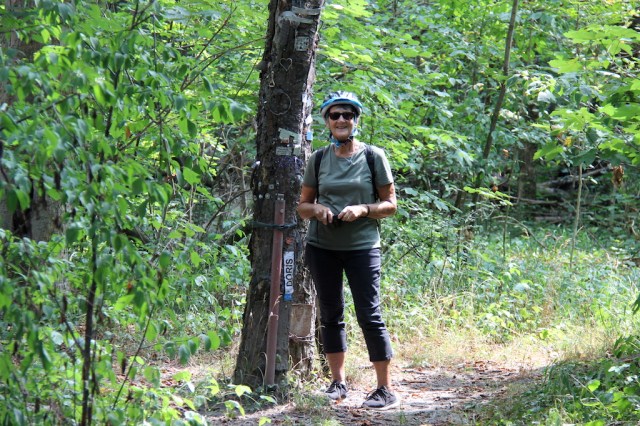
Bev at the nail tree in the forest in Prater Park Vienna.
En route to our Couchsurfing host we happened upon the Belvedere Palace, one of Vienna’s popular tourist attractions. For a grand atmosphere, the Belvedere Palace takes a lot of beating. There are many parts to the palace but the main sections are the Upper and Lower Belvedere.
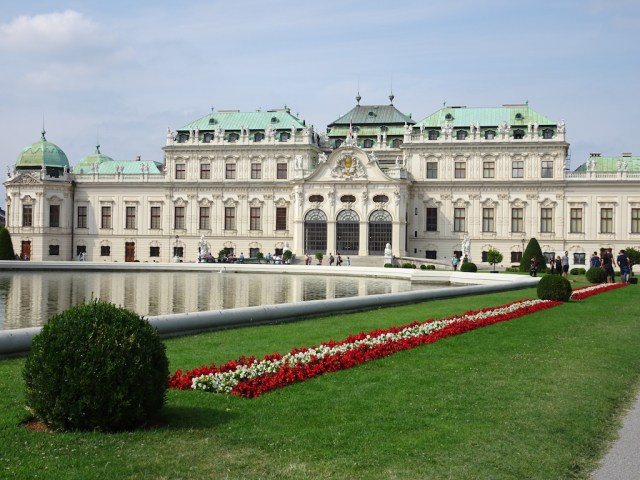
Upper Belvedere Palace
The owner and the man with sufficient vision to have the palaces built was Prince Eugene of Savoy, one of the Holy Roman Empire’s most distinguished statesmen and military commanders.
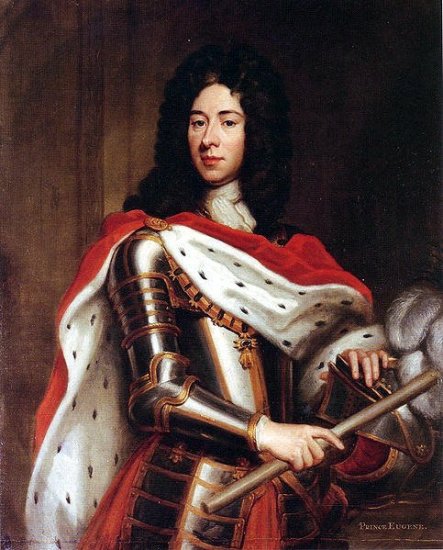
Godfrey Kneller’s image of the Prince Eugene of Savoy
Image credit: Image in the public domain via Wikipedia.
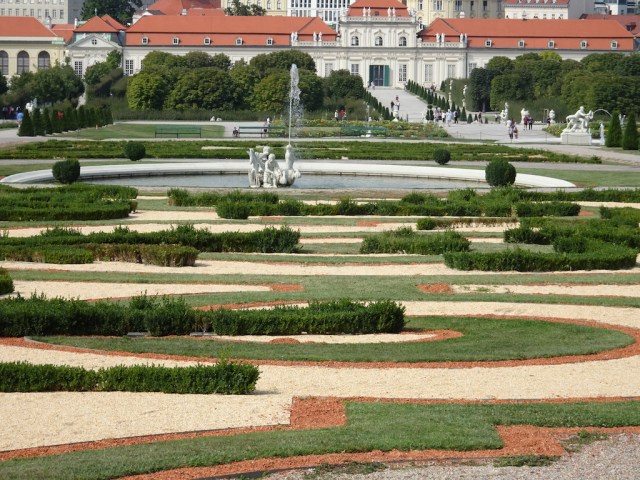
The gardens of the Belvedere Palace.
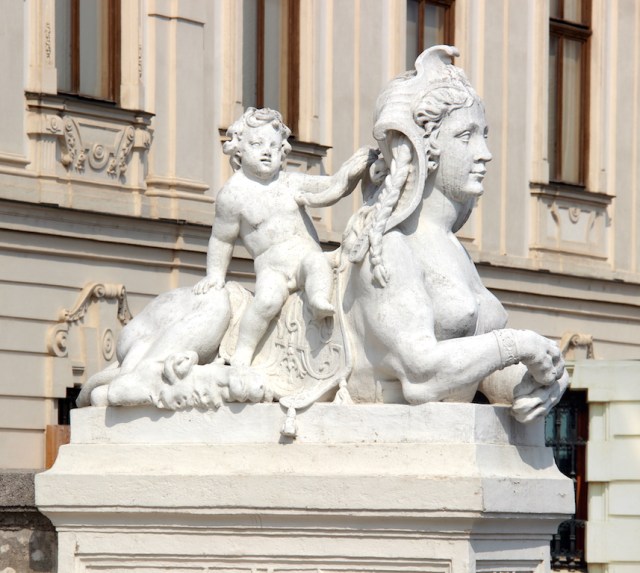
A sphinx statue outside the Upper Belvedere Palace.
A sculpture such as the one above with a woman’s torso and an animal body is called a sphinx (or sphynx). A sphinx is a prominent mythological figure in past Greek and Egyptian culture; they were often regarded as a spiritual guardian. One could easily dismiss the Baroque sphinx at the entrance of the Upper Belvedere Palace as being put there for decorative purposes but I get a feeling a lot of discussion would have gone on about its location. The combination of half human and half animal creations indicated man/woman’s love of animals.
_______________________________________________________
Vienna
Following our two day journey from Bratislava to Vienna we spent another two nights with couchsurfer host Maria and her husband Jean-Baptiste. During our previous visit Jean-Baptiste was in France with their children visiting his parents. Maria and JB were great couchsurfing hosts and they are great advocates for the organisation.
As I mentioned previously I was hoping we were going to pass through Vienna and not dilly-dally. But in retrospect had we passed through quickly we would not have been able to find the preserved example of a nail tree. Overnight I couldn’t help but think about the trees Bev came across the day before so I researched nail tree history and found an ancient example in the city centre as well as a nail-covered statue.
Not only was the nail tree on our list for visiting but there was a cat café and the Strauss Monument.
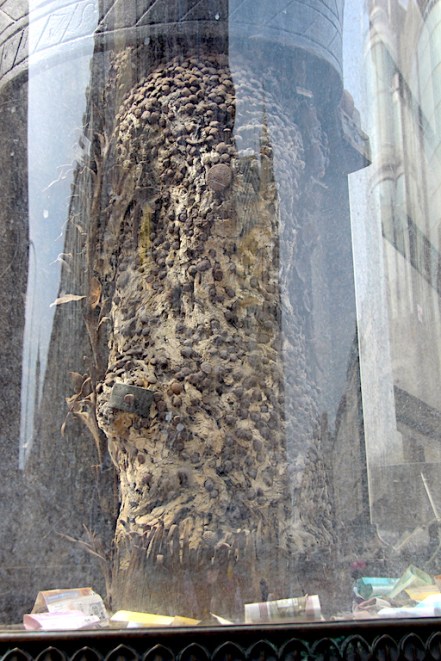
An encased and preserved section of a nail tree in Vienna.
Research in the 1970s dated the encased tree above to approximately 1400 years old and the first nail would have been driven into the tree whilst it was still alive.
Nail trees were common throughout south-eastern Europe in the Middle Ages. It is thought that the practice of driving nails, which were extremely valuable at the time, into trees was an act of sacrifice with the hope of good luck in the future. In later years during WW2 the nail trees of Europe inspired a similar practice, nail men were used as a way of creating national pride.
Bev and I went off in search of a nail man and found the statue of a medieval knight covered with nails next to the Vienna City Hall. It was erected in 1915 to raise funds for the widows and orphans of fallen soldiers. Donors were allowed to drive a nail into the wooden figure. The following images show the nail man we found.
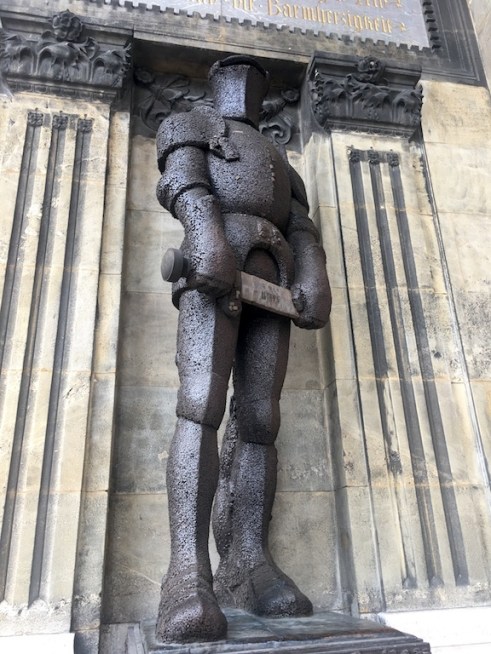
A nail man we found in Vienna in the form of a medieval knight.
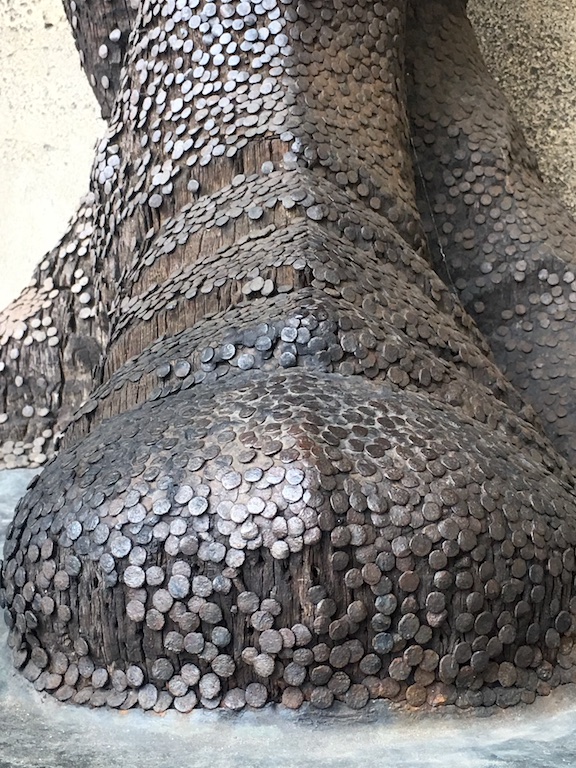
The nail man’s boot.
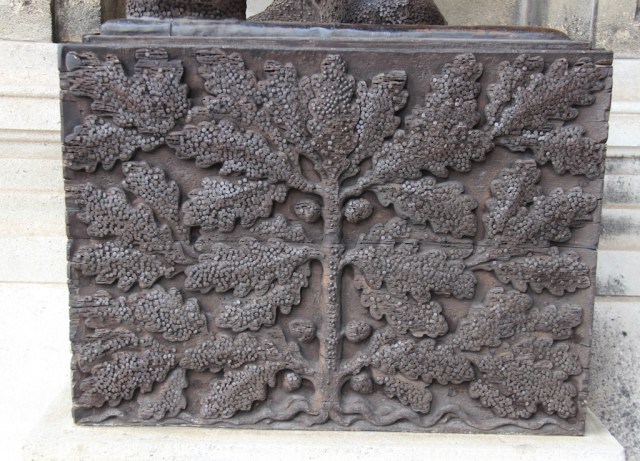
The pedestal on which the nail man stands.
Our next visit on the to do list was the Johann Strauss Monument in the State Park. Bev and I last visited the statue in 1972. At that time mist was hanging low around the statue and it gave it a surreal appearance. To our surprise, out of the mist came a group of people, some of whom seemed to be floating as they walked. One of the group approached us and said they were dancers from behind the Iron Curtain. Our mysterious man suggested we attend a performance of the Moscow Moiseyev Dance Company in which he performed and gave us two complimentary tickets for the performance the next day. The dancer wanted to chat but his associates called him as they were leaving the park and he danced away into the mist, leaving Bev and I dumbfounded. It was a once-in-a-lifetime encounter with such a graceful man. Of course we attended the dance performance the next day. It is worth going to YouTube to watch performances of the Moiseyev Dance Company. The precision and execution of the dance steps will hold you in awe.
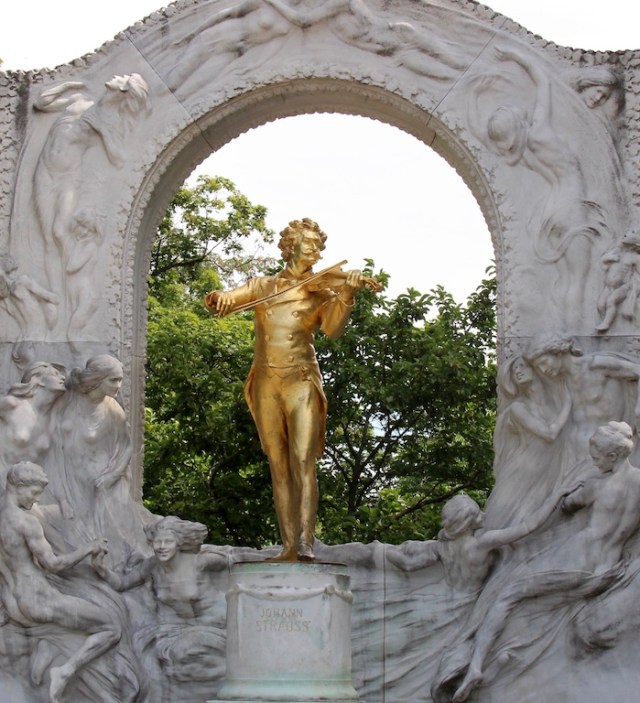
The Strauss Monument, not shrouded in mist.
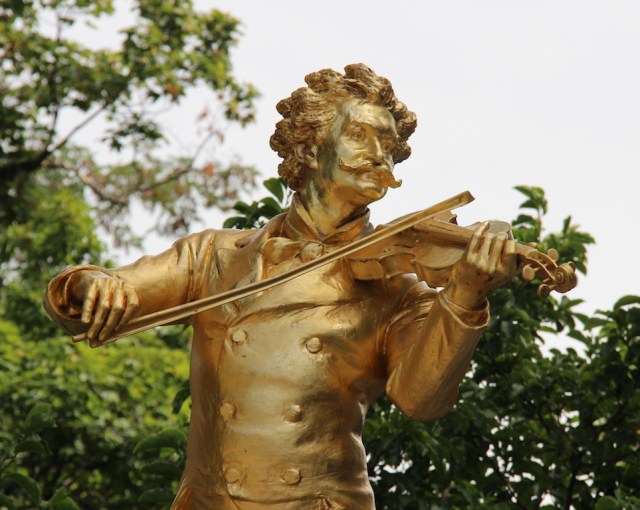
The man himself, Johann Strauss ll. The statue is not made from gold but gilded bronze.
Johann Strauss II was born into a Catholic family near Vienna in 1825. Against his father’s wishes he secretly studied music. His father, also a musician, knew how difficult and demanding it was and tried to discourage his son by threatening to beat him if he showed any interest in music.
Following his father’s abandonment of the family for a mistress, Strauss II was able to devote his energies to a career as a composer and he became known as the King of the Waltz. His most famous piece would be the Blue Danube Waltz.
The day we visited the Strauss Monument many tourists were milling around snapping with their phones but we reflected on our 1972 experience with the Moiseyev Ballet when there were very few tourists.
Our final attraction on our to-do list was to visit a cat café. When one is ignorant of a fact it is often said ‘You must be living under a log’. Well, I have to admit I have been living under a log when it comes to knowledge of cat cafes. Cat cafes number 700 worldwide and my reading indicates there are even cat cafés in Australia. Apparently in Australia cat cafes are going gangbusters. There is one cat café in Melbourne where the owner is quoted as saying, ‘Since opening in 2016 interest has been overwhelming. I’m ditching the glass partition and unleashing the entire floor to my twelve furry friends.’
The Neko Café entrance in Vienna. Note: Neko is Japanese for cat.
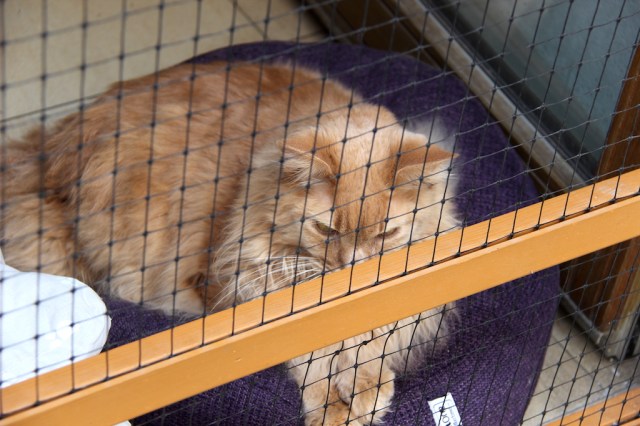
A resident cat looking out from the Neko Café.
Bev and I didn’t go into the Neko for ‘café and kuchen’ as the sign on the door said ‘No Photographs Inside’ and in addition, I am not a lover of cats. I think about the untold damage they have done to the marsupial and reptile populations in Australia. I’m happier going into a café in Greece where, as you enter, you are given a water spray bottle to shoot at the cats to keep them away from your table. Strangely enough though, whenever I enter a room and there is a cat in residence it always comes to me and climbs on my lap. Do these cats know something? Are they trying to win my affection and convert me into a cat lover?
If you love furry friends being close to you when eating, go into a cat café and absorb the catmosphere!
That’s the end of this post. The following posts will detail our journey from Vienna towards Zurich following the Danube River. We veered from the river to spend some days in the Austrian lakes area visiting with Bev’s brother. Make a comment if you wish.


Fabulous commentary Fred! Having been in Vienna a few times I was surprised that I hadn’t heard of nor seen the nail tree. I look forward to hearing about more adventures. We were in Salzburg last August when our son Luke was performing in the Salzburg Music Festival.
Shauna and Rod Stoker
Hi Shauna and Rod
Good to hear from you re Vienna. Once we discovered the nail tree I started looking for them and I’m pretty sure we found another one in Colmar France. It was not standing as such but used in a building as part of its construction. I have yet to write about Colmar but I am getting closer. Writing about our travels so long after the event is a nostalgic trip for us now and we are both enjoying re-living the trip. I have been giving thought to making vlogs (videos on YouTube) of our travels as I have been watching a bike trip by a German couple Louisa and Tobi who are riding their bikes around the world, their presentations are so professional that I have been inspired. You can follow them on YouTube.
Thanks again for your comment Fred and Bev